The importance of Diversity, Equity, and Inclusion in medical communications
- sallyhassan4
- Mar 11, 2025
- 6 min read
Updated: Mar 12, 2025
Healthcare inequalities
Marginalized communities were disproportionately affected by the coronavirus-19 (COVID-19) pandemic in the United Kingdom (UK) and the United States of America (USA) (1-3)

In the USA, structural racism† has also been described as a root cause of health inequalities (4)
In hospitals in England, the mortality rate from COVID-19 among black African ethnic groups was 3.5 times higher versus white British groups (May 2020 data) (3)
Potential reasons include the overrepresentation of black, Asian, and minority ethnic (BAME) people in frontline roles, unequal distribution of socioeconomic resources, disproportionate risks to BAME staff within the NHS, and high predisposition to certain diseases in some ethnic groups, which have been linked to poorer outcomes from the disease (3)
Mistrust concerning participation in clinical trials
In a qualitative study that investigated obstacles to research participation among African Americans (N=70), mistrust of the healthcare system was found to be a primary barrier (5)
Originates from historical events, e.g., the Tuskegee syphilis study (1932-1972), where to track the natural history of syphilis, African American male participants (N=600) were provided no effective care, despite being recruited by the promise of free medical care and severe progressive health problems from the disease, including blindness, mental impairment, and death (5,6)
Reinforced by health system issues and discrimination (5)

Why is it valuable to have greater diversity in clinical trials?
When trial participants are homogenous (e.g., mainly one gender, ethnicity, or age group), trial outcomes could be skewed (8)
This may lead to non-generalizable clinical knowledge (8)
Cardiovascular health and outcomes vary among racial and ethnic groups (8)
Diverse participation in clinical trials may result in more complete and robust data to widen our understanding of ethnic differences in treatment responses and may also help decrease treatment outcome disparities (8)
Barriers and potential solutions to the participation of minority or ethnic groups in clinical trials (8)
Barrier | Potential solutions |
Mistrusting the process |
|
Discomfort with the process |
|
Limited information |
|
Time and resource constraints |
|
Limited awareness |
|
The possible impact of being in a marginalized group
The World Health Organization recognizes discrimination as one of several social difficulties that can lead to mental disorders and physical illness (9,10)
Members of a marginalized group are at risk of having mental health conditions due to discrimination (9)
Discrimination causes harm through the body’s stress response, which, over time, negatively impacts the affected person’s psychology and physiology (9,11)
Sadly, patients with mental disorders also sometimes experience stigma and discrimination, which worsens their condition (9,12)
Lack of diversity in dermatology textbooks
In dermatology, images are critical for diagnoses (13)
Limited representation of black and brown skin in medical journals/textbooks has persisted for decades (13,14)
A study of general medicine textbooks demonstrated that only 4.5% of images were of dark skin (14)
A lack of images of darker skin poses an obstacle to the correct medical education for healthcare professionals (HCPs) and appropriate treatment plan for patients (13)

What can we do to improve the situation?

Plain language summaries for improving patient access to information

Inclusive language for more equitable healthcare
It is essential to understand patient preferences for language (16)
Steer clear of labeling that equates the patient with their condition (Table)
Avoid “suffers from” when mentioning patients with chronic diseases
Engage with communities to produce culturally relevant, unbiased communication that generates trust through joint decision-making
Provide plain-language health communications in the patient’s language (16)
Consider that language evolves, and context is very important (16)
Use inclusive language, which is essential for the mental health of patients (9)
A few examples of inclusive language for words related to health (16,9)
Language often used | More inclusive language |
An epileptic | A person with epilepsy/seizure disorder |
Birth defect | A person with a congenital disability/birth anomaly |
Cancer patient | A person with (type) cancer |
Combat the disease | Manage or treat the disease |
Diabetic patient | A patient living with diabetes |
Disabled person | A person with a disability |
Hypertensive patient | Patient with a history of hypertension |
Mental illness | Mental health condition |
Wheelchair-bound, confined to a wheelchair | Wheelchair user |
Website content accessibility for people with disabilities


Summary
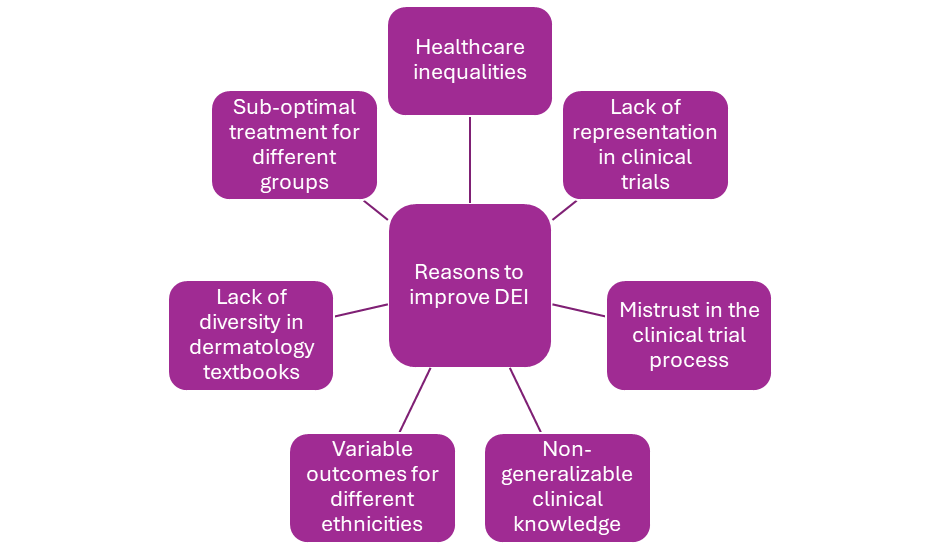
In summary, to improve DEI in medical communications, try to be a….

Footnotes
*Values are age-adjusted rate ratios standardized to the 2019 US intercensal population estimate. Calculations used only 65% of case reports with race and ethnicity, which may result in inaccurate relative risk estimates among the different groups.
†Ways in which societies foster racial discrimination within housing, education, employment, earnings, benefits, credit, media, healthcare, and criminal justice.
‡Flesch reading ease and Flesch-Kincaid Grade level.
§Written description of an image or graphic that a screen reader can read out loud.
||This is known as the “camel case.”
¶Arial, Calibri, Helvetica, or Verdana.
Abbreviations
BAME, black, Asian, and minority ethnic; COVID-19, coronavirus-19; DEI, Diversity, equity, and inclusion; GIF, graphics interchange format; HCP, healthcare professional; NHS, National Health Service; PLS, plain language summary; UK, United Kingdom; USA, United States.
References
1. The Editors. Black Health Matters. Scientific American 2020; 323(2):8 https://www.scientificamerican.com/article/too-many-black-americans-are-dying-from-covid-19/ (Accessed 28 February 2025).
2. Centers for Disease Control and Prevention. Risk for COVID-19 Infection, Hospitalization, and Death By Race/Ethnicity. https://archive.cdc.gov/#/details?q=Risk%20for%20COVID-19%20Infection,%20Hospitalization,%20and%20Death%20By%20Race/Ethnicity.%20&start=0&rows=10&url=https://www.cdc.gov/coronavirus/2019-ncov/covid-data/investigations-discovery/hospitalization-death-by-race-ethnicity.html (Accessed 28 February 2025).
3. Otu A, et al. One country, two crises: what Covid-19 reveals about health inequalities among BAME communities in the United Kingdom and the sustainability of its health system? Int J Equity Health 2020;19(1):189.
4. Bailey ZD, et al. Structural racism and health inequities in the USA: evidence and interventions. Lancet 2017;389(10077):1453-1463.
5. Scharff DP et al. More than Tuskegee: understanding mistrust about research participation. J Health Care Poor Underserved 2010;21(3):879-897.
6. Nix E. Tuskegee Experiment: The Infamous Syphilis Study. History. https://www.history.com/news/the-infamous-40-year-tuskegee-study (Accessed 28 February 2025).
7. FDA report. 2015-2016 Global participation in clinical trials report. https://www.fda.gov/files/drugs/published/2015---2016-Global-Clinical-Trials-Report.pdf (Accessed 22 November 2022).
8. Clark LT, et al. Increasing Diversity in Clinical Trials: Overcoming Critical Barriers. Curr Probl Cardiol 2019;44(5):148-172. Figure adapted from this reference.
9. Nakagawa D. Inclusive language: A hidden power at the hands of medical writers. EMWA: Medical writing 2021; 30(3): 118-123. https://journal.emwa.org/medical-decision-making-and-health-technology-assessment/the-crofter-sustainable-communications/article/10030/the-crofter_sustainable-communications.pdf (Accessed 23 November 2022).
10. Compton MT, Shim RS. The social determinants of mental health. Focus 2015;13(4):419–25. https://focus.psychiatryonline.org/doi/pdf/10.1176/appi.focus.20150017 (Accessed 06 March 2025).
11. Sederer LI. The Social Determinants of Mental Health. Psychiatr Serv 2015;67(2):234–5.
12. Burns JK. Mental health and inequity: a human rights approach to inequality, discrimination, and mental disability. Health Hum Rights 2009;11(2):19–31.
13. Lee McFarling U. Dermatology faces a reckoning: Lack of darker skin in textbooks and journals harms care for patients of color. STAT. https://www.statnews.com/2020/07/21/dermatology-faces-reckoning-lack-of-darker-skin-in-textbooks-journals-harms-patients-of-color/ (published 21 July 2020; accessed 06 March 2025).
14. Louie P, Wilkes R. Representations of race and skin tone in medical textbook imagery. Soc Sci Med. 2018;202:38-42.
15. Skobe C et al. Equity, Diversity, and Inclusion: Defining a Roadmap for Our Profession. The MAP Newsletter. https://ismpp-newsletter.com/2020/10/21/equity-diversity-and-inclusion-defining-a-roadmap-for-our-profession/ (Accessed 06 March 2025).
16. Chukwumerije N. Equitable Health Care Requires Inclusive Language. Harvard Business Review. https://hbr.org/2022/07/equitable-health-care-requires-inclusive-language (Accessed 06 March 2025).
17. Colston D et al. Diversity, Equity, and Inclusion Embraces Accessibility. AMWA 2022;37(3):16-20. https://amwajournal.org/index.php/amwa/article/view/173/153 (Accessed 06 March 2025).
18. Blyth J et al. We Need to Talk about PLS…Exploring the Opportunities of Plain-Language Summaries. ISMPP: The MAP newsletter. https://ismpp-newsletter.com/2019/05/01/we-need-to-talk-about-plsexploring-the-opportunities-of-plain-language-summaries/ (Accessed 06 March 2025).

Comments